Introduction
Libertarians are not exclusively interested in libertarianism; rather, libertarianism functions as a living principle, a lens through which we examine social relations, institutions, and the boundaries of knowledge itself. It invites not only political analysis, but also a broader inquiry into how ideas are formed, challenged, and defended within society. In this sense, one of the grounding insights of libertarians and classical liberals concerns the nature and limits of knowledge and science, how we come to know what we know, and how institutions react when that knowledge is questioned. The case of Graham Hancock is particularly relevant here, as it illustrates both the potential gaps in scientific understanding and the often defensive attitudes of scientific establishments toward dissent. What follows is one such segment: an exploration of intellectual freedom, scientific authority, and the limits of what we claim to know.
Graham Hancock and the Questions Academia Would Rather Avoid
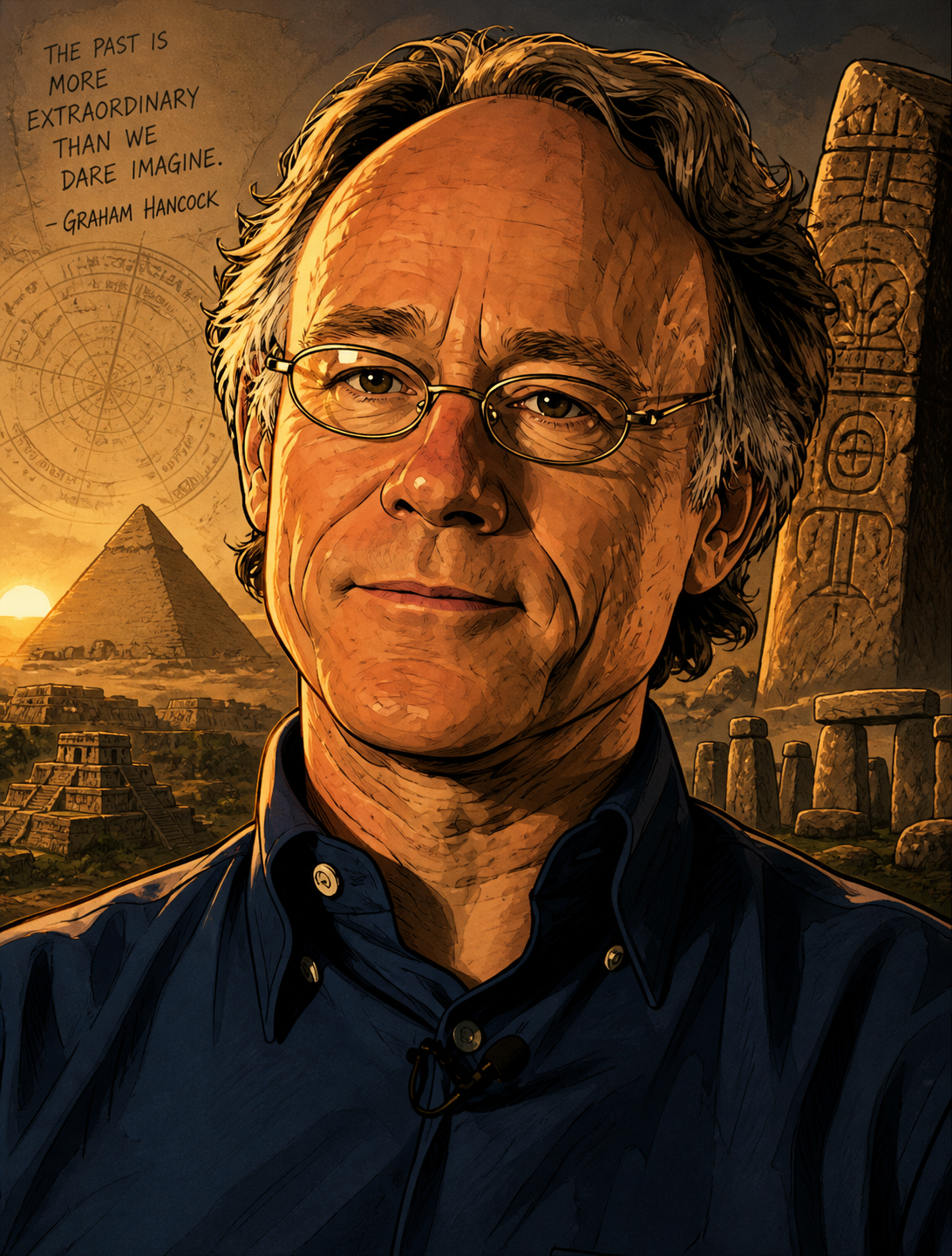
Graham Hancock is not an archaeologist, but a journalist who asks questions that mainstream archaeology often finds uncomfortable. For decades, he has argued that human history may be far older, more complex, and more fragile than the dominant narrative suggests.
His main claim is straightforward, yet it challenges the prevailing view: advanced human societies may have existed before the end of the last Ice Age, and a global catastrophe erased their traces. In Hancock’s view, what we call civilization may not be the start of the story, but a restart after a collapse. His Netflix series Ancient Apocalypse brought these ideas to a mass audience and provoked harsh criticism from archaeologists who saw it as misleading, speculative, or irresponsible. But the intensity of the reaction raises a deeper question: why do some questions provoke such institutional defensiveness?
What Hancock Actually Proposes
Hancock’s argument rests on several interconnected hypotheses. He suggests that around 12,800 years ago, at the onset of the Younger Dryas, Earth experienced a dramatic climatic disruption, possibly caused by impacts from a comet or meteor. Sudden cooling, massive floods, rising sea levels, and widespread ecological collapse characterize this period.
According to Hancock, an advanced Ice Age civilization, not industrial, but sophisticated in astronomy, engineering, navigation, and stone construction, may have existed before this event. He argues that the catastrophe destroyed most of this culture’s physical evidence, particularly as coastlines were submerged and ice sheets melted.
He further claims that survivors may have passed fragments of knowledge to later hunter-gatherer societies, helping advance agriculture, monument building, and early religion. Sites like Göbekli Tepe, Gunung Padang, and the Giza Plateau are, according to him, anomalies that don’t fit into standard timelines.
Most importantly, Hancock does not claim certainty. He frames his work as hypothesis and pattern recognition, or an attempt to ask whether the current story of human origins might be incomplete.
Why These Ideas Trigger Such Strong Resistance
Archaeologists do raise valid concerns about Hancock’s work. They argue that he makes loose connections, relies more on patterns than on firm proof, and blurs the line between speculation and evidence, thereby weakening established research standards.
But there is another aspect to the reaction. Hancock is not just challenging individual interpretations; he is questioning the overall structure of the historical narrative. Entire academic careers, disciplines, and institutions are built around a particular timeline of human development. Revising that timeline would be destabilizing. The fight is not just about facts, but about authority, legitimacy, and who gets to define knowledge.
Hayek, Knowledge, and Why No One Sees the Whole Picture
This is where Friedrich Hayek offers a helpful distinction. He argued that knowledge is always limited and divided, and drew an important line between local knowledge and scientific knowledge. Local knowledge is practical and context-based, spread across society. Scientific knowledge aims to be systematic and general, built through evidence and shared methods. But even scientific knowledge is incomplete and provisional, shaped by what can be observed, preserved, and studied.
Furthermore, Hayek warned that serious error begins when scientists overestimate what their methods can actually deliver, mistaking the appearance of precision for real understanding. When scientific institutions forget these limits and treat current theories as final truths, they fall into the very “pretence” Hayek cautioned against. Progress does not come from certainty imposed from above, but from questioning, testing, and revising ideas in light of their unavoidable limits.
In archaeology, this warning is significant. Our understanding of the past is fragmentary: evidence erodes, coastlines vanish, and entire cultures may leave little behind. In such conditions, the absence of evidence is not always evidence of absence. Hancock works in this area of uncertainty, focusing on the gap between what science can prove today and what it may dismiss too quickly. His critics are right to demand evidence and rigor. Still, Hayek’s insight reminds us that demanding complete certainty before inquiry even begins risks turning scientific humility into intellectual overconfidence, the very pretence of knowledge Hayek warned against.
Science Is a Process, Not a Permission Structure
Science advances by questioning assumptions, not by defending them. Many ideas we now take for granted began as speculative challenges to dominant views. When Nicolaus Copernicus proposed that the Earth was not the center of the universe, his heliocentric model was dismissed as heretical and subversive, contradicting both religious doctrine and scientific authority. Yet over time, this radical idea reshaped astronomy and transformed our understanding of humanity’s place in the cosmos. The same pattern repeated with germ theory and continental drift, ideas that were initially mocked or rejected, only to later revolutionize entire scientific fields.
What we now call “mainstream science” was itself born as an alternative to older orthodoxies. Consensus can be helpful, but it should never become a veto on inquiry. From a freedom standpoint, the proper response to controversial ideas is not suppression but competition. If Hancock is wrong, his arguments should be challenged openly and rigorously. Bad ideas do not need censorship; they need better ideas. As Hayek warned, when authority replaces discovery, knowledge stagnates, and the same risk arises when scientific institutions focus more on policing boundaries than exploring uncertainty.
Why Hancock Matters, Even If He’s Wrong
The real threat to science is not speculation, but fear of being wrong. Errors can be corrected, dogma cannot.
Confucius captured this long ago: “He who knows and knows that he knows is a wise man… he who knows not and knows not that he knows not is a fool.” Scientific progress depends on epistemic humility, the recognition that human knowledge is often limited. Graham Hancock may ultimately be right or wrong, but his importance lies elsewhere. He reminds us that science is not a closed book. It is an ongoing conversation, shaped as much by dissent as by agreement. Conclusively, when science refuses to challenge, becoming self-protective rather than self-corrective, it no longer defends truth but the establishment.
References
- Netflix. (2022– ). Ancient Apocalypse [Television series]. Netflix,
- Dibble, F. (2022, December 6). The dangers of Ancient Apocalypse’s pseudoscience. Sapiens.
- Fridman, L. (Host). Graham Hancock (Transcript). Lex Fridman Podcast.
- Hancock, G. (2023). HancockG23 [Blog/Article].
- Hancock, G. (2022). HancockG22—SAA [Blog/Article].
- JRE Podcast. Graham Hancock [Podcast episode].
- Hellman, R. (2022, October 25). Professor can comment on Netflix’s ‘Ancient Apocalypse,’ pseudo-archaeology. KU News Service.
- Hayek, F. A. (1945). The use of knowledge in society. American Economic Review, 35(4), 519–530.
- Liberty Fund. (n.d.). Hayek and the problem of scientific knowledge (Conference abstract).
- Britannica, T. Editors of Encyclopaedia. (n.d.). Heliocentrism. Encyclopædia Britannica.
- Gupta, A. (n.d.). Hundred scientists [PDF].
- UC Berkeley, Museum of Paleontology. (n.d.). Alfred Wegener and continental drift.
Luminet, J.-P. (2008). Is science nearing its limits? Summarizing dialogue. arXiv.