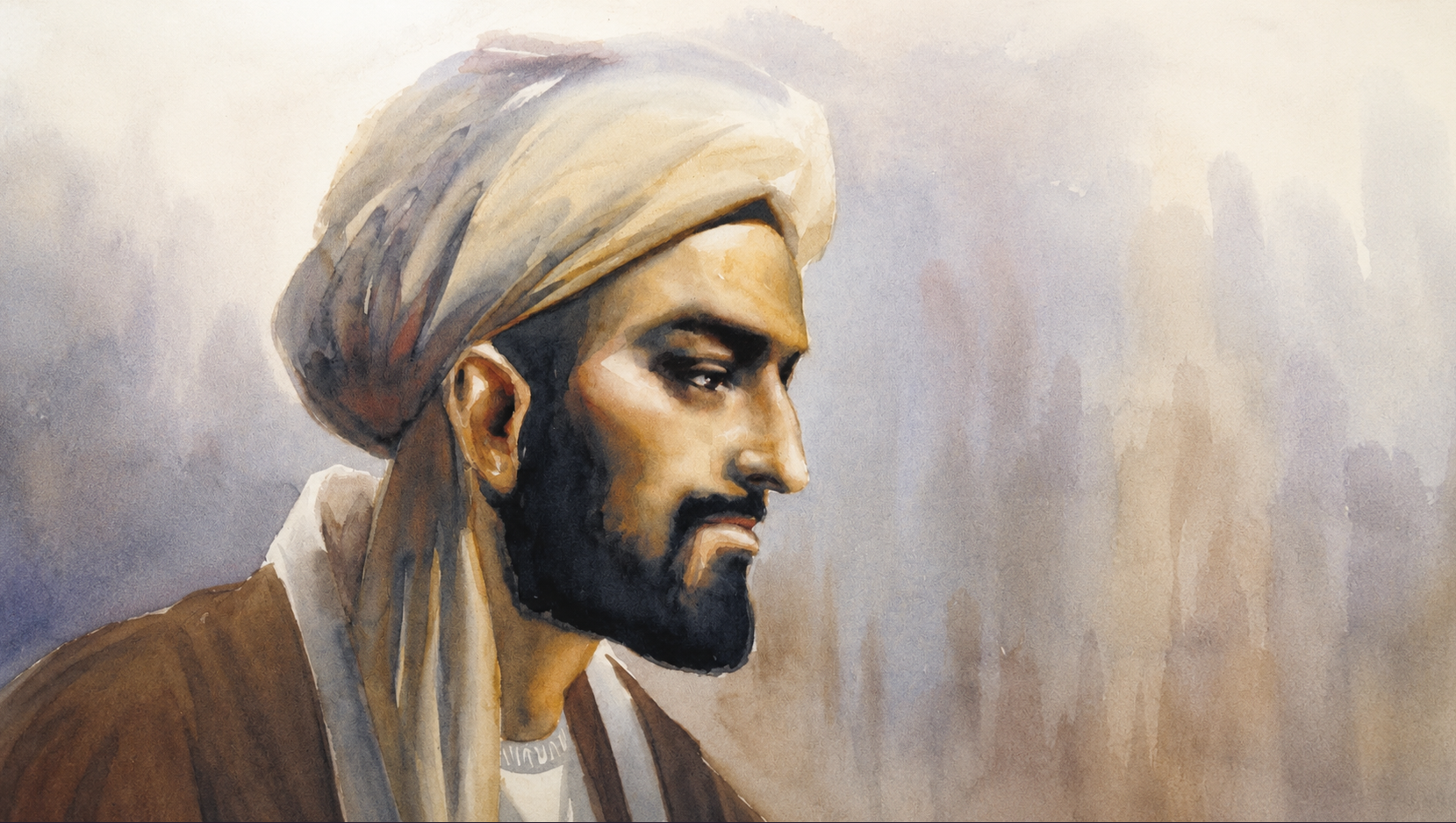
Image citation: Ibn Khaldun by Waqas Ahmed, licenced under Wikimedia Commons
When the state keeps taking more, it often ends up with less. The idea is usually treated as a modern insight, associated with tax curves, supply and demand, and other economic buzzwords. But Ibn Khaldun, the 14th-century North African historian and thinker, laid out the logic long before any of that language existed.
His work, the “Muqaddimah”, contains one of the clearest early arguments against excessive government power ever written. While Ibn Khaldun did not use the vocabulary of modern economics, he understood incentives with remarkable clarity. Having witnessed the rise and fall of many dynasties, he came to understand a lesson modern governments still grapple with: when the state grows too large, it risks consuming the very society it exists to protect.
What Khaldun Actually Argued
His fundamental idea was the theory of “Asabiyyah”, a concept usually translated as group cohesion. For Khaldun, this was the force behind every successful civilization. It was the glue, the shared loyalty, the collective energy that allowed a group of people to build something together and defend it when necessary. A strong sense of cohesion produces a strong society.
However, the problem is that state power corrupts that force. As a ruling dynasty or a political party consolidates control, the rulers grow distant from the people who brought them to power. They start spending more than they produce, and, crucially, they turn to taxation to bridge the gap. Today, that same impulse survives in our modern tax structures, proving that while the titles of the rulers change, the predatory nature of taxation by the state remains a historical constant.
Khaldun is most famous for his prophetic economic observation that low taxes on land encourage activity, while high taxes discourage it. He observed that early-stage rulers impose light taxes on a broad base of economic activity, and the result is a flourishing economy that generates real wealth. But as the state expands, with more officials, more palaces, more wars, more bureaucracy to maintain, the pressure to extract more revenue becomes irresistible. Tax rates go up, regulations multiply, and a merchant thinks twice before expanding his workshop. A farmer calculates whether the harvest is worth the effort after the tax collector takes his share. Gradually, economic activity slows down. Not because the people have become lazy, but because the incentives have been poisoned.
“When tax assessments and imposts upon the subjects are low, the latter have the energy and desire to do business… [and] the ruler’s revenues increase” – Khaldun wrote. He understood that when the tax rates rise steeply, commerce retreats into the informal economy or disappears, the tax base shrinks, and the state squeezes harder, accelerating the very decline it is trying to reverse.
This is no coincidence of phrasing. It reflects the same underlying logic we see today. Tax rates and tax revenues are not the same thing, and a government that confuses the two will eventually make its subjects poor while collecting less than it did before.
This logic, however, also goes beyond taxation. Once a government begins to grow through coercion rather than cooperation, it tends to expand its reach into administration, regulation, patronage, and control. The result is not strength but fragility. A bloated state can look powerful while quietly hollowing out the society beneath it.
The Parallels
The instinct to link Khaldun with modern thinkers is understandable. One of those thinkers, Frederic Bastiat, writing in 19th-century France, was obsessed with what he called “the unseen”. The idea that a tax increase may produce visible revenue for the treasury, visible jobs for some people, a visible benefit for one sector, but the unseen costs are often larger, with fewer investments, weaker growth, and less innovation. Ibn Khaldun saw the same pattern in a premodern context. The state may appear richer in the short run, but it often weakens the long-run foundations of wealth.
Bastiat also argued that the state should be judged by its effects and not by its intentions. Governments love to claim they are creating prosperity by redistributing wealth, protecting industries, or managing society for the public good. But in truth, when the government takes from some to give to others, it distorts incentives, redirects resources, and often leaves society worse off.
The resemblance to Ibn Khaldun is obvious. Both thinkers saw that prosperity depends on voluntary exchange, productive effort, and social cooperation. Both understood that the state becomes dangerous when it treats the economy as something it can command without consequences.
But we should resist the urge to make Khaldun a medieval Bastiat. He was not an ideological libertarian, no matter how interesting that would sound. He did not argue for minimal government as a matter of natural rights or moral principle. His concern was empirical, because he watched dynasties collapse and worked backwards to find the mechanisms. He accepted that rulers would inevitably expand their reach; he saw it as practically a law of political nature, and his analysis served as a warning.
This distinction matters and, in some ways, makes his argument more powerful. Bastiat was arguing from principle, and skeptics could dismiss him as ideologically motivated. Khaldun was arguing from pattern recognition, because he had studied the dynasties and nations that would eventually fall.
The Modern Application
Modern governments are far more complex than medieval dynasties, but the basic problem remains. Bureaucracies rarely shrink on their own. They accumulate regulations. While every one of them may be justified as necessary, humane, or efficient, they also impose burdens, delay, uncertainty, and reduced initiative.
High tax rates do not only affect the wealthy, despite what political rhetoric often suggests. They affect hiring, saving, expansion, entrepreneurship, and risk-taking across the entire society. When the state takes too much, it does not merely redistribute existing wealth. It changes the creation of wealth itself.
In this sense, bureaucracy and taxation are connected. The larger the state becomes, the more it tends to justify its size by pointing to the problems it has itself helped create. Poor public services lead to calls for more funding. Weak economic growth leads to more intervention. Social trust declines, and officials respond with more oversight.
Ibn Khaldun would recognize the pattern immediately. A state that overreaches weakens the social and economic vitality it depends on. Eventually, it loses legitimacy, effectiveness, and revenue. It becomes strong in appearance and weak in substance.
The Oldest Warning Is Still the Best One
Ibn Khaldun did not try to write a libertarian manifesto. He uncovered a timeless law of political economy. That is why his work still matters. Long before modern debates about government, he understood that prosperity depends on incentives, and that rulers who ignore incentives eventually destroy the conditions of their own power.