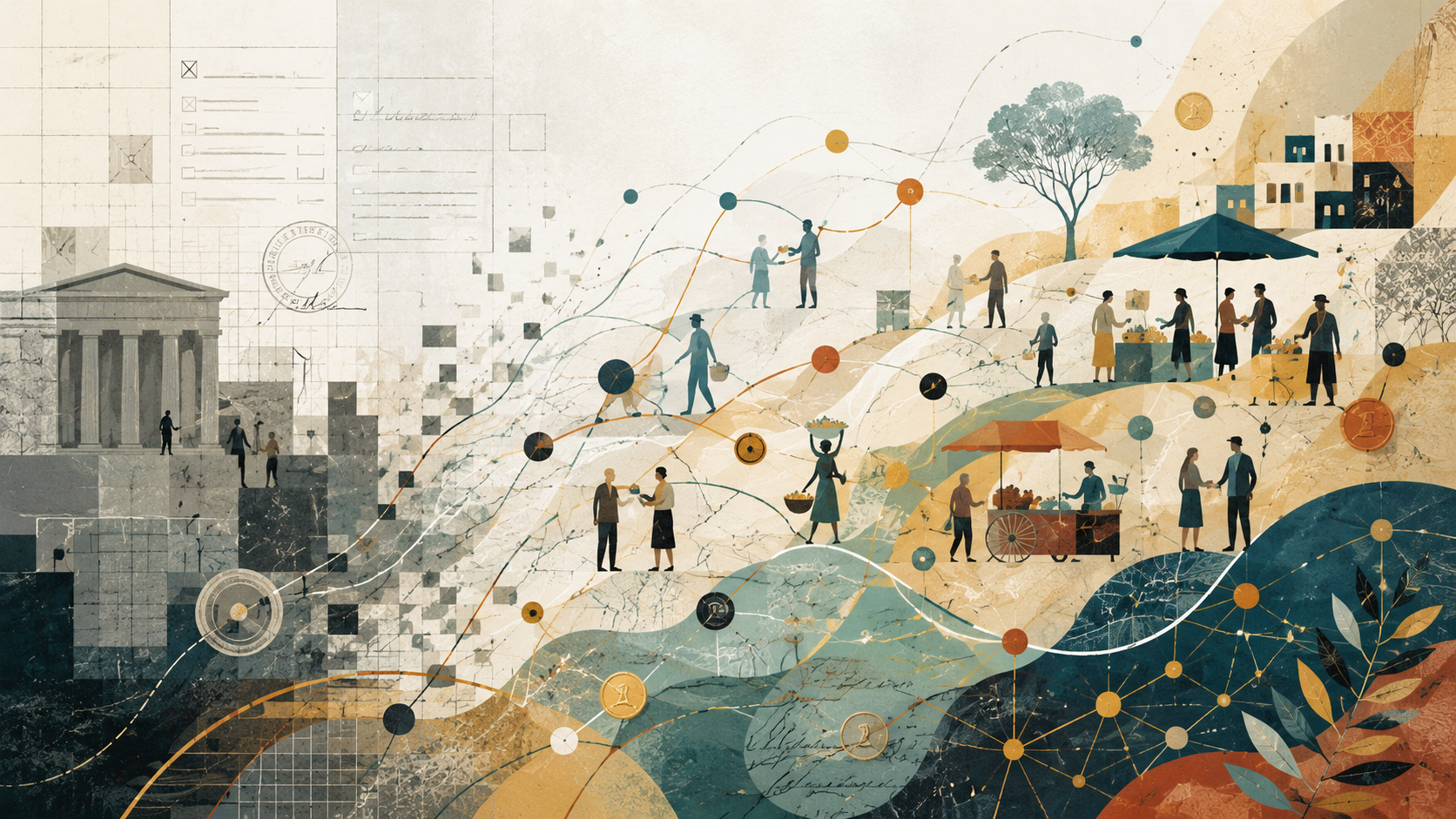
Walk down any residential street and you will notice a curious, common pattern. A homeowner’s private garden is often a well-tended space filled with blooming flowers and vibrant life. In contrast, the public park we share is frequently damaged by litter, ruined grass, and broken benches. Why does this difference exist? The answer lies in the deep connection between ownership and care, a principle that Frédéric Bastiat understood nearly two centuries ago.
In his seminal work, The Law, Bastiat defined the essence of human existence through a triad: personality, freedom, and property. For Bastiat, property was not simply about the accumulation of material wealth, it was the physical expression of human responsibility. He argued that when a resource has a specific owner, it gains a protector.
We often treat nature as a collective gift, focusing on the shared beauty of our environment. However, the practical reality, often described in the framework of Free-Market Environmentalism, is that without the defense of clear legal and physical boundaries, that gift is left defenseless. To remain green and sustainable, the earth does not need more governmental reforms. Instead, it requires the focused, individual stewardship that only private property rights can provide.
The Tragedy of the Commons
The observation that we often mistreat the resources we share most was formalized by ecologist Garrett Hardin in his influential 1968 essay, “The Tragedy of the Commons”. Hardin’s logic is straightforward. When a resource is free and open to everyone, each person has a logical, short-term incentive to take as much as possible before it is gone. For example, if a forest is open to all for logging, each individual will try to cut as many trees as they can to maximize their own profit. They know that if they do not take the wood today, someone else will, eventually leaving the land empty and lifeless.
This situation creates a deep incentive problem. In a system where access is open to all, individual efforts toward conservation are often rendered useless. If I choose to protect a tree in a public forest for the sake of the environment, there is no legal assurance that another person will not harvest it the next day. My decision to save the resource does not actually protect it. Instead, it simply passes the benefit of that tree to the next person who passes by. To demonstrate how different institutional frameworks solve or worsen this incentive problem, this article focuses on the real-world environmental outcomes of three specific countries: Kenya, Zimbabwe, and Iceland.
The Elephant in the Room: State Prohibition vs. Community Ownership in Kenya and Zimbabwe
Protecting the environment is often more about economics than biology. We can see this clearly when we ask why some animal populations grow while others disappear. The answer usually comes down to whether the people living nearby see these animals as a valuable resource or a dangerous burden.
In the 1970s, Kenya followed a strategy that many people naturally support: they banned the ivory trade and made the government the official owner of all wild animals. This “protection through prohibition” was meant to save elephants, but the results were devastating. Because the elephants belonged to the state, they effectively belonged to no one. Local Kenyan farmers did not see the elephants as a gift; they saw them as dangerous animals that destroyed their crops and food. Since the local people could not legally earn money from the wildlife, they often ignored the activities of illegal hunters or even helped them, causing Kenya’s elephant population to decrease rapidly.
A similar crisis of state control unfolds in Zimbabwe, though through a different bureaucratic failure. Instead of managing a thriving ecosystem, the Zimbabwean government has been left stuck guarding multimillion-dollar ivory stockpiles, accumulated from natural deaths and confiscations. Because international trade bans and rigid state regulations prevent them from legally selling these stockpiles, the government lacks the basic funds urgently needed for park security. Whether through Kenya’s outright prohibition or Zimbabwe’s centralized stockpiling, top-down state ownership consistently fails to create the economic incentives required for real conservation.
While these debates started decades ago, they are anything but history; they form the frontline of today’s active wildlife battles. Even though the global illegal wildlife trade remains aggressive, localized community ownership continues to prove its resilience. For instance, Zimbabwe’s newly implemented Elephant Management Plan directly integrates local communities into asset management and human-wildlife conflict mitigation. Rather than relying on top-down bans, this approach treats conservation as a localized economic engine.
Contrast the historical failures with the “Campfire Program” in Zimbabwe and similar communal conservancies in Namibia. Instead of keeping all control in the hands of the central government, these countries transferred ownership and management rights to the local communities. Suddenly, the elephant was no longer a state-owned problem, it became a valuable community asset. Local people began to earn a profit from sustainable tourism and carefully managed hunting programs. This shift changed their motivations completely. When a villager sees an elephant as a source of income for their family and a way to build local schools or clinics, they become the most effective force against illegal hunting. The long-term data validates this shift: while continental poaching remains an issue, elephant populations in these specific community-managed regions have more than doubled over the past few decades, anchoring some of the largest remaining herds on the continent today.
The lesson is clear. When a resource has a defined owner and a clear value, it becomes too important to lose. While strict bans often lead to illegal black markets, private and community ownership creates dedicated guardians for the natural world.
The Icelandic Miracle: Fencing the Ocean
If the “Tragedy of the Commons” was born at sea, its cure was found in the North Atlantic. For decades, Iceland’s fishing industry was in serious trouble. Because the ocean was open to everyone, every boat raced to catch as many fish as possible before they were all gone. It was a “race to the bottom” that threatened to destroy both the environment and the economy. To fix this, the government introduced a smart solution – Individual Transferable Quotas (ITQs).
Instead of treating the ocean as an unregulated, open-access resource, this system gave fishermen specific, legal rights to a certain amount of fish. This changed everything. Suddenly, fish stocks were no longer a “free lunch”, they became a valuable asset that the owners wanted to protect. If an Icelandic fisherman overfishes today, he is directly damaging the value of his own property for next year. Since these rights can be bought and sold, they naturally end up in the hands of the most efficient and careful fishers.
Today, the results of this quota reform are undeniable: the fishing pressure on vital species like cod has dropped to a historic low, and fish populations have finally begun to recover. This “miracle” didn’t happen because people suddenly became unselfish; it happened because the “fence” was extended to the water. By turning a shared resource into private property, Iceland made sure that making a profit now meant keeping the ocean healthy for the future.
The Responsibility Behind the Fence
The ongoing initiatives from Zimbabwe’s savannahs and Iceland’s oceans provide a clear alternative to failed state controls. They prove that when people have a personal stake in their environment, they become its most effective guardians. By linking property rights to responsibility, as Bastiat suggested, we create a system where protecting nature actually benefits the individual. This shift from “everyone’s resource” to “managed property” has repeatedly saved species and industries from collapse.
However, property rights are not a universal solution for every ecological challenge. As the Icelandic case demonstrates, the quota system can lead to a concentration of wealth, making it difficult for small-scale operators to enter the industry. Similarly, community-led programs depend heavily on local cooperation to prevent internal conflicts. While ownership is a powerful tool for sustainability, its success depends on its design and whether it respects the specific needs of the local community.
The path to a greener world is not found in top-down government bans, but in empowering those who live on the land. While no system is flawless, property rights offer a more stable foundation for conservation than distant bureaucracy. The goal is to build a world of responsible owners who possess both the legal power and the personal incentive to protect the earth for future generations.