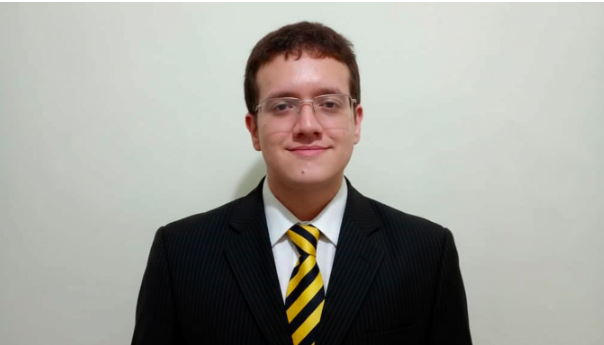
By Thiago Emanuel Candido Catão Pereira de Freitas
My full name is … well, you can see it above. I’m not gonna type the whole thing again.
Sometimes I joke that the Portuguese colonizers weren’t content with merely taking our gold; they had to leave behind these sprawling surnames as a final, bureaucratic coup. Forms online still reject it occasionally, convinced no real person could possibly have this many syllables attached to their identity.
Before Students For Liberty entered my life, that identity, other than all the syllables, was … startlingly ordinary. Totally unremarkable.
I wasn’t the student who set the world ablaze with brilliance, though I was competent enough to pass examinations and curious enough to read beyond the curriculum. Literature captivated me: those vast interior worlds Dostoevsky constructed, the philosophical depths Thomas Mann explored through his characters, the profound moral vision of Tolstoy’s prose.
But here’s the delicious irony: I’m actually a self-taught software engineer. While my friends were studying literature for school, I was reading instruction manuals. While they debated Kant, I debugged code. Something about the elegant logic of programming appealed to the same part of my brain that loved philosophy; both are, in their own ways, attempts to create order from chaos, to build systems that make sense of our messy reality.
Politics Enters the Picture
But politics? That was one thing that held no interest for me whatsoever. I was profoundly apolitical, one of those insufferable teenagers who considered themselves “above” such tribal squabbles. I had better things to contemplate, thank you very much.
I won’t dramatize the specifics, but I lived through the consequences of well-intentioned leftist politicians’ disastrous public policy decisions. We all did, here in Brazil.
The disaster didn’t present as abstract statistics in some economist’s paper, but in my daily life: The very policies designed to help people like me created obstacles I’m still navigating around. Good intentions, as the saying goes, pave a very particular sort of road.
This suffering could have embittered me entirely. Instead, it ignited something unexpected: curiosity about politics.
Why did these benevolent-sounding policies produce such catastrophic results? Why did reality refuse to align with the beautiful rhetoric? I began reading, watching videos, devouring books, following arguments wherever they led. This was no longer abstract philosophy; this was survival, understanding the forces shaping my world.
The reading led me, almost inevitably, toward Classical Liberalism. I dislike labels, but I cannot deny my appreciation for those Enlightenment philosophers who believed in human potential, in free exchange, and the radical notion that ordinary people might govern their own lives.
Contemporary authors like Thomas Sowell articulated what I’d experienced but couldn’t yet express: how the seen and unseen consequences of policy diverge, how cultural capital matters, how incentives shape behavior more than intentions ever could.
The greatest irony? The Left’s catastrophic measures pushed me toward the very philosophy they oppose. They create their own opposition, one confused teenager at a time.
Everything Changed When I Heard about Students For Liberty
I first heard about Students For Liberty during late adolescence. It seemed like just another commitment, another thing to navigate. Years passed. Life happened: work, relationships, the chaos of becoming an adult.
Eventually, I re-enrolled at university. One ordinary afternoon, procrastinating as one does, I was watching a video by Raphaël Lima, a Brazilian YouTuber whose channel IDEIAS RADICAIS (Radical Ideas) I’d been following.
Toward the end, almost casually, he invited viewers to join Students For Liberty Brazil.
Something changed in that moment. Call it epiphany, call it recognition — suddenly, I realized I needed to contribute to this … whatever it was. Moment. Movement. Calling. Reading Sowell alone in my room wouldn’t change anything; ideas need communities, networks, voices.
I filled out the application form somewhat nervously. Weeks later — long enough that I’d half-forgotten — I received a response. There were tests, interviews, assessments. Then, wonderfully, acceptance. I’d become a Local Coordinator for Students For Liberty Brazil.
Now, coordinating anything across a country as big as Brazil presents challenges. But here’s where my day job as an IT professional became valuable. I could assist various SFL study groups throughout Brazil, helping with digital infrastructure, communications, and connecting isolated coordinators. Technology collapsed those impossible distances.
I was surprised at how fulfilling this work was. There’s something profoundly meaningful about facilitating spaces where young people wrestle with ideas, where genuine discourse happens, where minds change — including my own.
My 15 Minutes of Fame: The Hoover Institution’s Essay Contest
Then, in 2025, the Executive Director of Students For Liberty Brazil presented us coordinators with an opportunity: the Thomas Sowell Essay Contest 2025, organized by the Hoover Institution at Stanford University.
Learn about Siddharth Gundapaneni, another SFLer who’s applying the skills he gained with us to achieve big things at the Hoover Institution: 1 Video + Students 4 Liberty = A Mi5sion For Life
I submitted an essay about my life — this very journey I’m describing — and how Sowell’s patient, empirical approach had transformed my worldview. I wrote about culture, incentives, and unintended consequences. About how knowledge without ideology became possible.
I never expected to win. Honestly, submitting felt sufficient — articulating these thoughts clarified them.
Then the email arrived. I’d won. Moreover, I was invited to attend an event alongside authors I’d long admired: Niall Ferguson, Steven Pinker, and others whose books lined my shelves.
That ordinary boy with the ridiculously long Portuguese name — that self-taught programmer who once couldn’t have cared less about politics — was being recognized for contributing to these conversations. It still seems impossible.
Editor’s Note: Thiago’s essay, which won the Hoover Institution’s 2025 Thomas Sowell Essay Contest, was a response to the question: How have Thomas Sowell’s ideas changed your view of the world? It is well worth your time. From Code to Consciousness: How Thomas Sowell Rewired My Brazilian Developer Mind.
My 3 Big Takeaways
Here’s what I want young people who are reading this to understand:
- I never imagined I would “change the world” or anything like that. I was just curious, just willing to show up, just stubborn enough to keep learning.
- The world needs more spaces for genuine discourse, for wrestling honestly with hard questions, for building coalitions around principles rather than tribes. You don’t need to be special. You just need to be willing.
- And for Pete’s sake, join Students For Liberty! Not because it’ll necessarily lead to prizes or recognition (though it might), but because ideas matter, and they need your voice, your perspective, your energy. Your ordinary experiences, properly examined, contain extraordinary insights.
As local coordinator for Students For Liberty Brazil, Thiago dedicates himself to the advancement of liberty. Thiago has served on the Executive Board of the organization Ordem Espontânea (Spontaneous Order), collaborating in planning and coordination efforts. He also participated in the creation of the Dragão do Mar website, helping to expand its digital presence and communication of liberal initiatives in his region. His scarce moments of leisure are invariably surrendered to the intellectual rigors of chess.