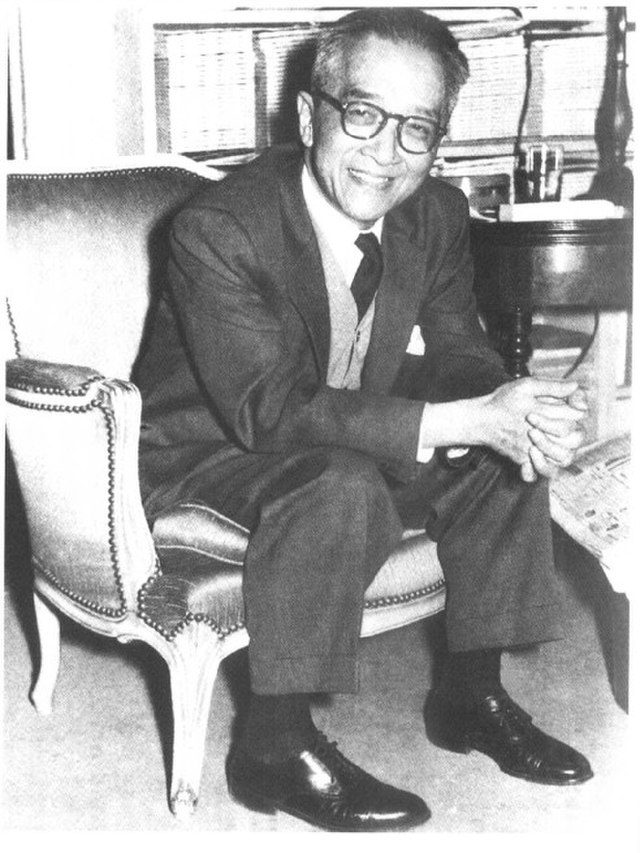
Image citation: Hu Shih 1956, licensed under Wikimedia Commons
Hu Shih, former president of both Peking University and Academia Sinica, and known for his ties to Chinese liberalism and John Dewey’s (American philosopher and psychologist) experimentalism was an influential figure in Chinese politics and academia. He was also China’s Ambassador to the United States during 1938–1942.
Despite Hu Shih’s substantial achievements and impact, there were extended periods where he was officially a “forbidden figure” and was repeatedly and publicly denounced. During Mao Zedong’s regime Hu Shih’s writings were officially purged and censored from circulation. In most of the propaganda red films inside China, the surname “Hu” was mostly given towards counter-revolutionary figures or bourgeois landlords. To understand the Chinese Communist Party (CCP’s) organized efforts to eliminate Hu Shih’s influence from intellectual discourse in China, it becomes important to know his politics and philosophy.
Hu Shih and New Culture Movement
Hu Shih’s choice to take up a lectureship at Peking University marked the beginning of China’s philosophical transformation. Having translated the works of John Dewey, he had already embraced pragmatic, evolutionary reform and progressive ideals. At Peking University, he met Chen Duxiu, the editor of the respected journal New Youth. The New Youth was a literacy magazine aimed to challenge the feudal Confucian traditions and advance individual liberty and equality to foster social progress. Hu Shih was invited to edit this influential publication alongside Chen Duxiu (who would become the first General Secretary of the CCP) and Li Dazhao (who would be recognized as the father of Chinese Marxism).
Both Hu Shih and Chen Duxiu encouraged young Chinese to critically examine Confucian teachings and discard outdated elements. Yet, it would be inaccurate to label them as entirely anti-Confucian. While they mocked outmoded customs and pseudo-Confucian institutions incompatible with modern science and democracy, they did however maintain some respect for the core philosophical principles of Confucianism. Contrary to the accusations made by Chinese traditionalists, Shih and Chen did not blindly adopt Western values, they instead applied a critical assessment. Their belief also stemmed from the views Western ideas were not inherently flawless and thus should not be accepted uncritically.
In his own writings, Shih identified several shortcomings within Chinese society and the impacts of pseudo-Confucianism on it, “We know for a fact our society is a rotten one; yet we claim ours to be a land of the saints and sages. We know for a fact our society is infested with corruption and nepotism; yet we shower eulogies on the corrupted. We know for a fact that we are inflicted with incurable diseases; yet we claim that all is very fine and well. Why don’t we realize that if we want to cure the diseases we must first of all admit the diseases are there; if we want to have a good government, we must first of all admit that the government we have today is a bad one; and if we want to improve on our society, we must first of all acknowledge our society, as it is, is rotten to the core”.
Through New Youth and the New Culture Movement, Hu Shih also spearheaded the use of vernacular Chinese in literature to replace complex Classical Chinese thereby, making reading accessible to the general public. He famously summarized this goal by stating, “A dead language can never produce a living literature.”
During 1910s-1920s before the foundings of Communist Party of China, Mao Zedong, the future leader of Communist Party of China as well as Lu Xun, the nominated writer for Nobel Prize in Literature, along with Chen Duxiu also played vital roles in vernacular Chinese movement. The efforts to critically evaluate outdated pseudo-Confucianism practices and promote the use of everyday vernacular Chinese in literature were collectively known as the New Culture Movement. Hu Shih also summarized the goals of this movement as: “study of the problems, import of knowledge, rearrangement of Chinese thoughts and building of a new culture.” Moreover, Hu Shih personally translated the lectures of Margaret Sanger, a famous birth control advocate, and integrated her ideas with China’s New Culture Movement to ignite national discussions on population, women’s rights, and modernising China,
Hu Shih, and May Fourth Movement: Liberalism vs Marxism
As an editor of New Youth journal, Hu Shih had close and brotherhood association with later CPC founders such as Chen Duxiu, Li Dazhao, and others. Among others, Li Dazhao was also quite an influential political leader who adopted Bolshevism as a political way forward for China, followed by Chen Duxiu. Yet, Hu Shih considered Bolshevism too violent and unpragmatic dogma as Hu Shih was convinced that social change must occur gradually (incrementally). He rejected the possibility of revolution or any sweeping ideology that promised to resolve all societal problems instantly—a view he articulated early on in the “problems versus isms” debate.
During those days, Marxism, Communism, and Bolshevism were used interchangeably even though there are distinctions between them. For that reason, Hu Shih opposed Marxism affiliated with Soviet experience because of his deep commitment to individualism, staunchly affirming that the rights of a person are independent of, and superior to, the demands of the collective and the state. Even though there were ideological differences between Hu Shih and other Marxist editors of the New Youth journal, he played a vital role in the May Fourth movement. At first, the May Fourth Movement focused on opposing Confucian culture and promoting a new culture where “democracy” and “science” are appreciated. The May Fourth Movement later played a role in progressive ideas such as “free love”, “feminism”, “labour rights” and “anti-imperialism”. Hu Shih personally viewed this entire period as the “Chinese Renaissance.”
Hu Shih and Communist Party of China
Hu Shih’s idea of “Discussion of Problems and Isms” suggested the youth to concentrate on practical problems rather than focusing excessively on political doctrines by warning: “The great danger of political doctrines is that they make people so self-contented that they may be led to think a fundamental solution is right here”. According to him, relying too much on ideology creates a dangerous sense of false satisfaction, leading people to prematurely believe they have found an easy, comprehensive answer to complex societal issues.
While Mao Zedong ultimately sided with Li Dazhao against Hu Shih during the debates related to the “Discussion of Problems and Isms”, Hu Shih’s opposition to those who use ideologies as a mere replacement for the rigorous work of problem-solving remains highly relevant. Even Li Dazhao, who held firmly to Marxism as his guiding principle, conceded ground to Hu Shih by acknowledging the vital necessity of thorough investigation before acting. Hu Shih’s anti-dogmatism was even adopted in secret by Mao himself in his writings against dogmatism. In his conversation with Edgar Snow for Red Star Over China, Mao Zedong described the evolution of his early political and intellectual development.
Mao stated that many of the student organizations he was involved in were significantly shaped by the ideas found in New Youth. He recalled that he first started reading the magazine while attending normal school and greatly respected the writings of Hu Shih and Chen Duxiu. These two figures became his new role models, taking the place of the earlier reformers, Liang Ch’i-ch’ao and Kang Yu-wei, whose influence he had already moved past. At that time, Mao characterized his thinking as a complex blend of various ideologies, including liberalism, democratic reformism, and Utopian socialism. He had strong, though perhaps imprecise, enthusiasm for concepts like “nineteenth-century democracy,” utopian ideals, and traditional liberalism. Above all, he held firm stances against militarism and imperialism. At that point in time, Mao Zedong had a meeting with Hu Shih. The purpose of this visit was for Mao to seek Hu Shih’s support for the struggle being undertaken by the students from Hunan province.
During the 1950s, Dr. Hu Shih saw two major threats to democracy in China emerge. On the left, he observed the rise of Marxism, promoted by intellectuals (including the founders of the Communist Party of China). On the right, he noted the Kuomintang (KMT) as an authoritarian nationalist group advocating for dictatorship. He firmly rejected both extremes, convinced that neither ideology was suitable for China. Despite writing few official political texts, he maintained an unwavering certainty that democracy was the sole appropriate governmental structure for China. Nonetheless, Hu Shih viewed the Kuomintang (KMT) government as the lesser of two evils when compared to the Chinese Communist Party (CPC). Consequently, the Chinese Communists, particularly under Mao Zedong, made repeated efforts to eradicate his influence on the mainland. Mao’s propaganda machine went so far as to consistently label him, Hu Shih, as the primary defender and “the running dog of imperialism.”
Shih rejected the notion of sudden upheaval, holding instead that true social transformation unfolds gradually, beginning with individuals and working upward from the grassroots. He said that true social progress requires freedom at the individual level contrary to the vanguardism of the elite Bolsheviks, and in his own word, “A group of slaves will never make a liberal and progressive country: such a country can be made up only of independent-minded and free-thinking people.”
CCP, led by Mao Zedong, made persistent attempts to either bribe or persuade Hu Shih to support their cause. When these efforts failed, the CCP launched a massive ideological campaign against him. Following the CCP’s directive, the Beijing Sanlian Joint Publishing Company produced an extensive eight-volume work titled “a Compilation of Critical Essays on Hu Shih’s Thought,” which totalled over 3 million words attacking Hu Shih and his ideas. The son of Hu Shih, Hu Sidu was ultimately targeted and driven to suicide driven by political pressure to denounce Hu Shih during the Hundred Flowers Campaign after his attempts to engage with the state were met with severe persecution.
Hu Shih as a Pioneer of Progressivism
Even within China, when thinking about the idea of radical democracy, the writings of Hu Shih are probably not the first example that comes to mind due to the decades of censorship CPC imposed against him. Instead, his concept of democracy has often been dismissed as “liberal” by the sympathizers of CPC and has always been dismissed as “westernizer” by not only the nationalist elements but also the conservative elements of Confucianism. However, these accusations fail to recognize Hu Shih’s own nuanced position. Even Hu Shih himself once wrote the following in his article “Our Attitude toward Modern Western Civilization”: “At present the most unfounded and more harmful distortion is to ridicule Western civilisation as materialistic and worship Eastern civilisation as spiritual.”
Hu Shih defined true materialism not as Western modernity, but as any civilization where people are so restricted by material conditions that they are unable to use intellectual power to improve their environment; he called this a nonprogressive society that obstructs spiritual fulfillment. His assertion, which opposed this simplistic categorization of civilizations, reveals that he was not just a “westerniser,” but a champion of free thinking, progressivism, and pragmatism.
Even though Hu Shih was devoted to the experimentalism of John Dewey, he also drew upon Confucian and Taoist traditions to challenge authoritarian rule, arguing that Chinese intellectual history carried an almost libertarian distrust of government interference, a long‑standing devotion to freedom in its many forms—intellectual, religious, and political—and a deeply rooted respect for the individual’s right to doubt and question even the most sacred truths. His advocacy for individualism, democracy, and liberal humanism was rooted not in ideological dogma, but in an empirical appreciation for the practical efficiency of these values in reality. Thus, his political thinking can be understood through the civil libertarian lens and share fundamental ideas commonly associated with libertarian traditions, such as individualism, voluntary cooperation, radical democracy, and a steadfast opposition to authoritarian control.