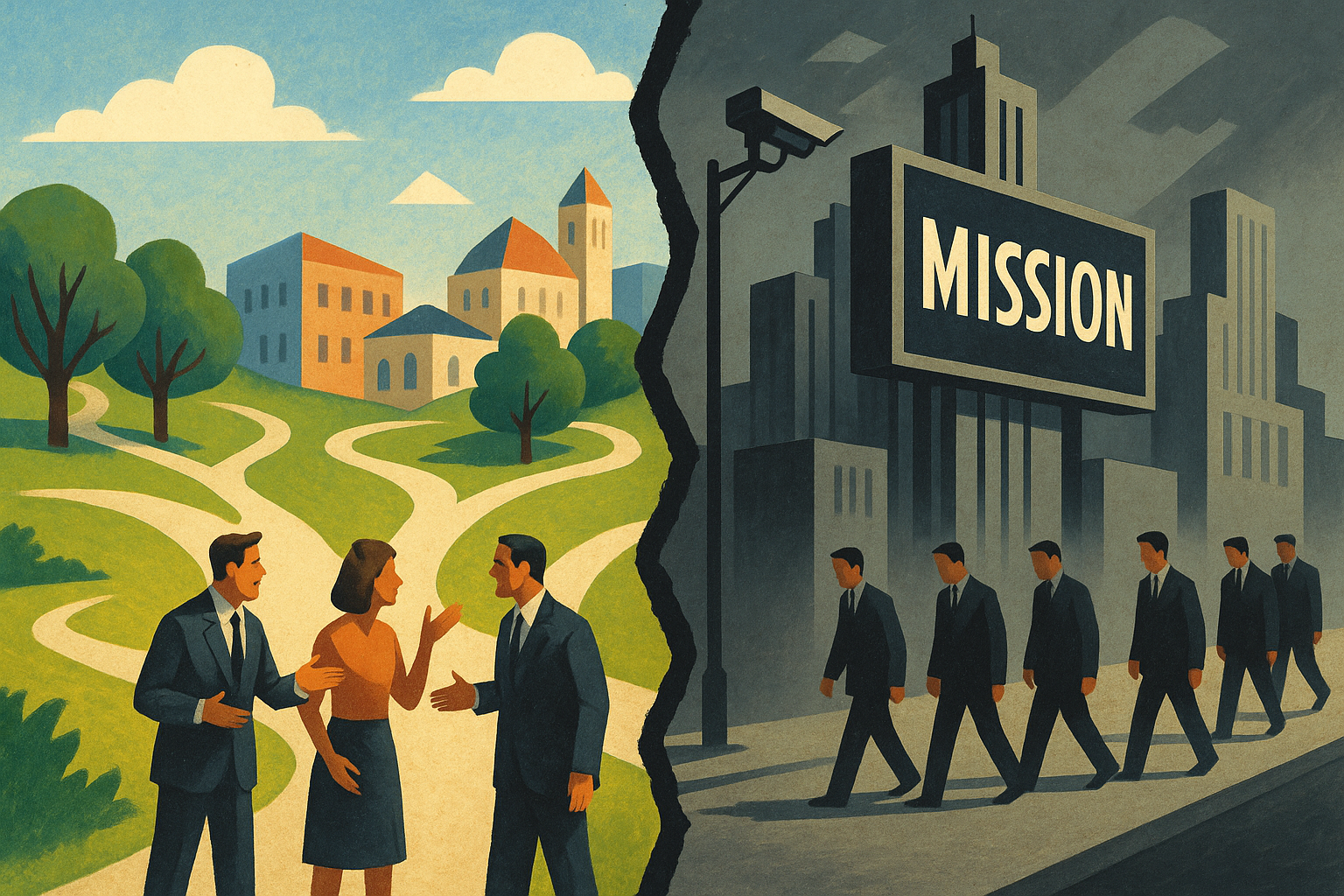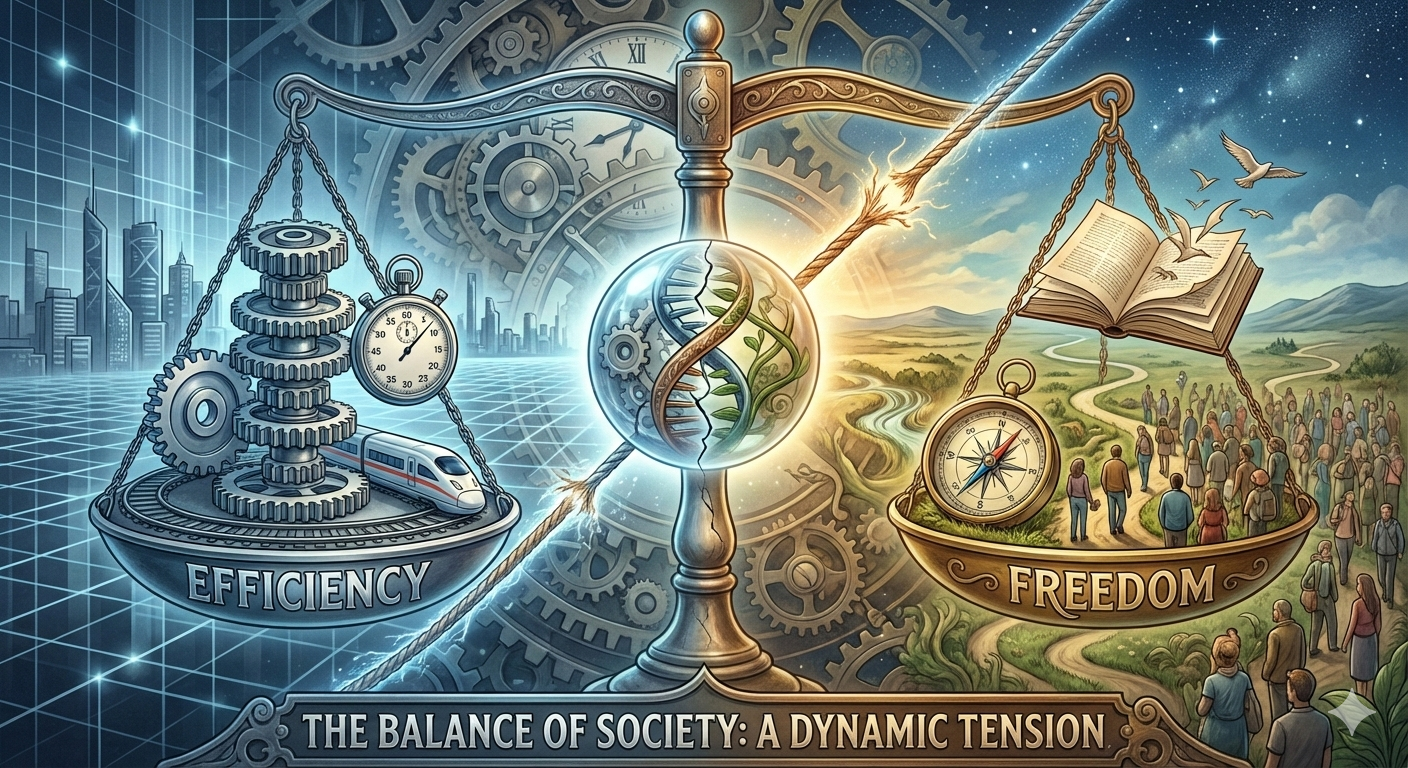
The tension that exists is between two classics: Adam Smith’s extent of the market, where specialization and exchange reinforce each other, because “the division of labor is limited by the extent of the market”, and Alexis de Tocqueville’s art of association, where civic life survives because people learn to act together. Smith’s division of labor delivers prosperity through specialization; Tocqueville’s civic associations safeguard liberty through engagement. Yet they can pull in opposite directions: specialization isolates, and isolation weakens democracy. This is not abstract: it decides whether the West stays free or slides into a new despotism.
Trade-off: Smith vs. Tocqueville
Is there a complementarity or a fundamental trade-off between Smith’s specialization and Tocqueville’s associationism? Do the gains from economic exchange create the conditions for civic engagement—or do they quietly crowd it out as specialization scales? Ultimately, can Tocquevillean association survive alongside Smithian division of labor, or does the very success of specialization begin to erode the habits and capacities on which freedom relies?
The Rise of an “Industrial Aristocracy”
Tocqueville warned that industry can rebuild hierarchy. In Chapter 20 of Democracy in America, the clash with Smith becomes visible. While Smith praises the division of labor, Tocqueville warns that as “the art makes progress, the artisan goes backward.” The master becomes “an administrator of a vast empire,” while the worker becomes weak and dependent. This creates a new “Manufacturing Aristocracy,” power that scales with division and dependence; in Tocqueville’s phrasing, “the one contracts no obligation to protect, nor the other to defend.” Tocqueville’s verdict is deliberately unsettling: the manufacturing aristocracy “is one of the harshest which ever existed in the world”—and yet “one of the most confined and least dangerous.” Tocqueville’s darkest worry is that this aristocracy can “impoverish the men it uses.” In the age of AI and Big Tech, the worry is no longer theoretical: scale and dependence can compound faster than civic counterweights can form.
The modern risk is trading state tyranny for corporate tyranny, or watching the two merge. The danger intensifies when profit turns into rent—when residual returns stop coming from value creation under competition and start coming from politically secured shelter. In plain terms: profit is disciplined by entry and consumer choice; rent is secured by gatekeeping, licenses, regulation-as-barrier, procurement, or narrative capture. When firms shift from competition to seeking protection and extracting value (rent-seeking—securing shelter, not competing), they rebuild feudal privilege inside a capitalist shell. The question is whether associational counterweights can scale as fast as economic concentration; if they cannot, politics becomes the binding constraint on liberty by default.
Specialization: Efficient but Isolating
Smith praised the pin factory for its efficiency and made a powerful case for specialization as a source of productivity. In our AI era, the pressure toward specialization only intensifies, becoming necessary, efficient, and hard to avoid. But Smith also underscored its human cost: repeated narrow tasks can make a worker “as stupid and ignorant as it is possible for a human creature to become.” Economic progress can purchase mental degradation; efficiency can come at the cost of the civic mind.
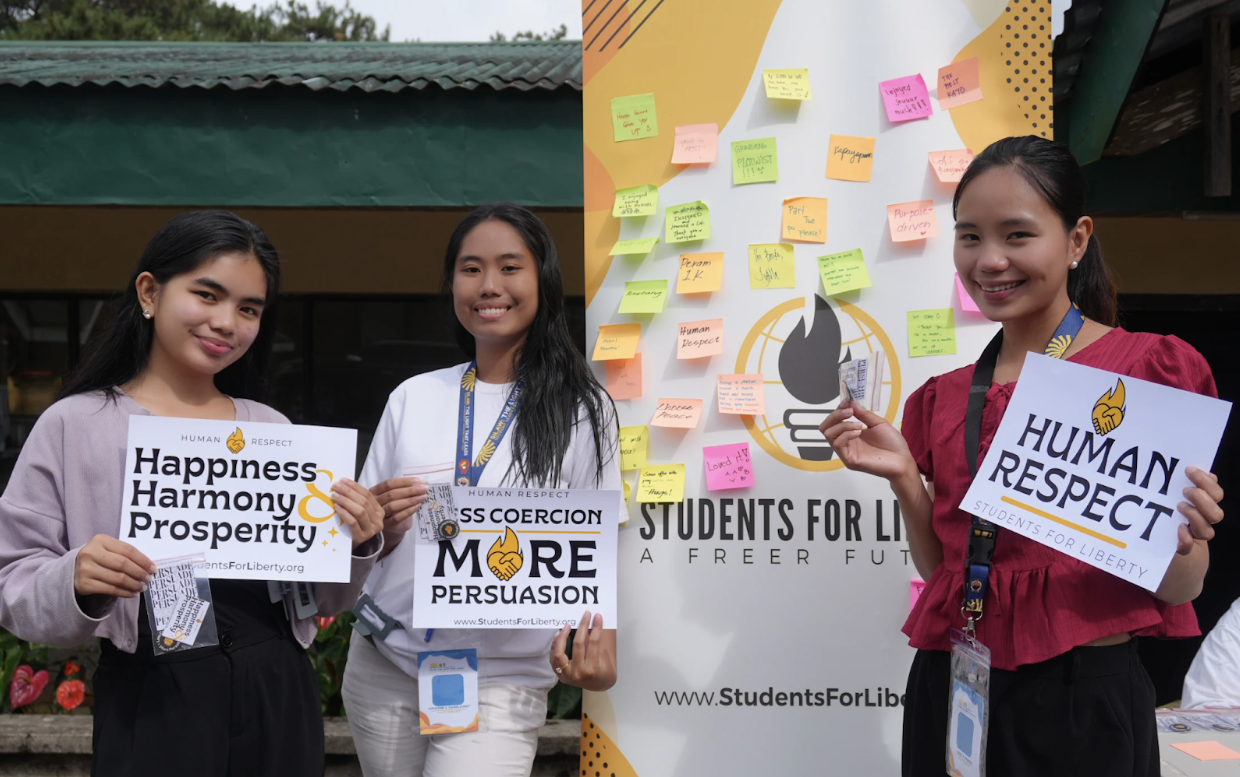
Specialization makes people technically powerful but civically weak. It isolates them in a niche, drains time and energy for voluntary civic duty, and normalizes the quiet surrender—“others will handle it”—while the social fabric thins. Tocqueville treats association as the core civic remedy for isolation: it is the practical “technology” that lets atomized individuals act together, and—through “self-interest properly understood”—links private incentives to public engagement.
The Choice: Exit or Civic Struggle?
This is the Smith–Tocqueville problem in another guise: frontier work versus civic work. It raises a hard question for intellectuals and economists today: isolate in the Ivory Tower to push the frontier of knowledge, or slow down to engage in the civic struggle and bring the majority on board through association and education?
For Tocqueville, the battle is civic and political. Exit into private comfort or pure inquiry is precisely how Tocqueville’s “soft despotism” becomes socially feasible: not by chains, but by disengagement. If we withdraw into private research while an industrial aristocracy rises—corporate, algorithmic, political, or hybrid—power vacuums do not remain empty: they are filled by organized forces, often illiberal, public or private. Economic and technological superiority (Smith’s legacy) is useless without the political will to defend the liberal order. Political liberty is the only corrective to the excesses of specialization; without it, efficiency turns into dependence.
Popper’s paradox of tolerance is blunt: tolerating organized intolerance can destroy tolerance itself. If we tolerate the intolerant—whether external autocrats or an internal industrial aristocracy—for the sake of quiet living, we lose liberty. We must accept the risk of civic conflict today to prevent the collapse of our institutions tomorrow. Therefore, the dilemma is stark: silence (continuing to advance knowledge) or risk (engaging in the social fray)? To engage in the “civic struggle” is not a distraction, but a moral imperative. Silence is not neutral when the baseline drifts.
The Risk: Erosion of Liberty
Modern life leaves little space for associational life. Day by day, apathy hollows out the stone. Historically, Europe (Italy, Germany, Spain) saw this erosion in the interwar period when inaction emboldened autocrats, passively allowing anti-democratic forces to gain ground. Today, the West risks repeating Giambattista Vico’s recurring cycles, with higher stakes and more lethal tools.
The Russian invasion of Ukraine is not a distant crisis—it is a test of whether democracies still possess the political will to defend the liberal settlement. It further erodes the peace and security that international law and the postwar institutions were meant to uphold. Tolerating aggression against an ally creates a structural breach in the institutional and moral strength of our democracies. Western democracies are divided, and that division is itself a signal: unchallenged violations teach that force works, invite further aggression, and degrade supranational commitments. The West’s hesitant response is a Pandora’s box: once aggression is rewarded, the precedent becomes a template. Dialogue among democracies works; institutions are far less effective against authoritarian regimes that treat agreements as optional—so deterrence matters precisely because some actors respond to weakness, not reason.
America holds military, technological, and economic superiority, yet hesitates—and that becomes information. Adversaries read it as a parameter, calibrating risk-taking to perceived weakness. Rearming Ukraine—and strengthening Western deterrence—can restore credibility by changing the expected payoff of aggression. As the late Roman writer Vegetius put it: si vis pacem, para bellum—if you want peace, prepare for war. Asking Ukraine to cede territory is inherently illiberal, authoritarian, and undemocratic.
Danger: Corporate or State Tyranny?
Which despotic threat is greater today: the State or the Corporation? Perhaps the distinction is blurring. We are witnessing what Shoshana Zuboff calls “surveillance capitalism”: a form of power built to predict—and increasingly steer—behavior at scale: control without visible chains, guidance without consent, modulation without responsibility. Here, the “soft despotism” Tocqueville feared meets the algorithmic efficiency of Big Tech.
The uncomfortable answer depends on the context. Europe currently preserves individual freedoms—perhaps the last place in the West to do so fully—but risks stagnation and strategic dependence if it fails to innovate and grow enough to command respect from more powerful rivals and “frenemies.” America, conversely, risks a form of “Russification”—call it techno-feudalism, crony capitalism, or something adjacent. Tocqueville admired America because it knew how to associate private interest with public good. If America loses this capacity due to polarization, isolation, and corporate dominance, it loses its antidote to despotism.
Economics vs. Politics
Individual ethics matter, but politics often acts as the “independent variable”; the economy has limits. Since the 2008 crisis, confidence in the Washington-Consensus era has weakened and demand for regulation and stability has risen. This marks a reversal: economic “optimality” is increasingly subordinated to political consensus. The current zeitgeist is suspicious of creative destruction—especially outside America, which remains a leading hub of bottom-up innovation through powerful academic–industrial ecosystems. Linked to the Smith–Tocqueville tension, the struggle now is political and requires associational capacity à la Tocqueville.
The Antitrust Dilemma: The Geometry of Power
Institutions (à la Montesquieu) face a structural conflict of interest. Restraining private power can end up protecting the State when there are no strong private counterweights; tolerating concentration can produce giants that escape any reasonable State control. Either way, the design problem is checks, balances, and the geometry of power—preventing both monopoly and Leviathan, and preventing their collusion.
Commitment and Reality
Smithian specialization risks severing contact with social reality. A concrete example: the new “Ora!” party in Italy struggles to recruit a high-level, full-time leadership class because the most capable individuals are already consumed by their specialized work. Politics is a leap into the void, yet it is the necessary social fight.
Clarification: Tocqueville’s engagement is civic first—rooted in associations of civil society—only later electoral and partisan. It begins with cultural, educational, informational, and event-based associations; political involvement is a later—and often natural, necessary—step. Disengagement is complicity. To avoid the “moral decline” of the West, we must prioritize the civic struggle. We need to be citizens first, specialists second.
Conclusion
Over the last fifty years, advanced welfare states—especially in parts of Northern Europe—ran ambitious, sometimes extreme experiments to find the maximum sustainable level of welfare, public spending, and assistance while trying to keep innovation and free enterprise alive. Peaks were later followed by reversals; the point here is not the accounting, but the signal: across social science, it is revealing to watch how preferences shift between development and inclusivity across cultural, political, and economic cycles.
“Frontier” economies have afforded themselves the luxury of inclusivity—a mark of civilization. Conversely, “catch-up” economies (like China and rising Southeast Asian stars) have prioritized speed over welfare and the environment, accepting higher financial volatility and social fragility.
However, the real danger today lies in failing to recognize new forms of totalitarianism as they emerge. The free market has nothing to do with granting privileges to the few. It is the opposite: it is isonomia—equal rules at the starting line, then open competition. Outcomes are unpredictable and beautiful precisely because they are not predetermined. A liberal order refuses any determinism of ends: it polices rules, not destinies.
As two esteemed Italian economists, Alesina and Giavazzi make the provocation explicit even in their title, “Il liberismo è di sinistra”: liberalism is “left-wing” insofar as it protects merit and relentlessly fights rent-seeking and privilege—not markets. In Mill’s spirit, we need open contestation of ideas—and open markets in goods—kept alive by constant vigilance, not closed by new monopolies.
History teaches us the maxim: eternal vigilance is the price of liberty.This piece builds on reflections from the Mercatus Center, following a sharp prompt from Professor Chris Coyne, to whom the author is grateful.