By Trevor Kraus, SFL Managing Editor
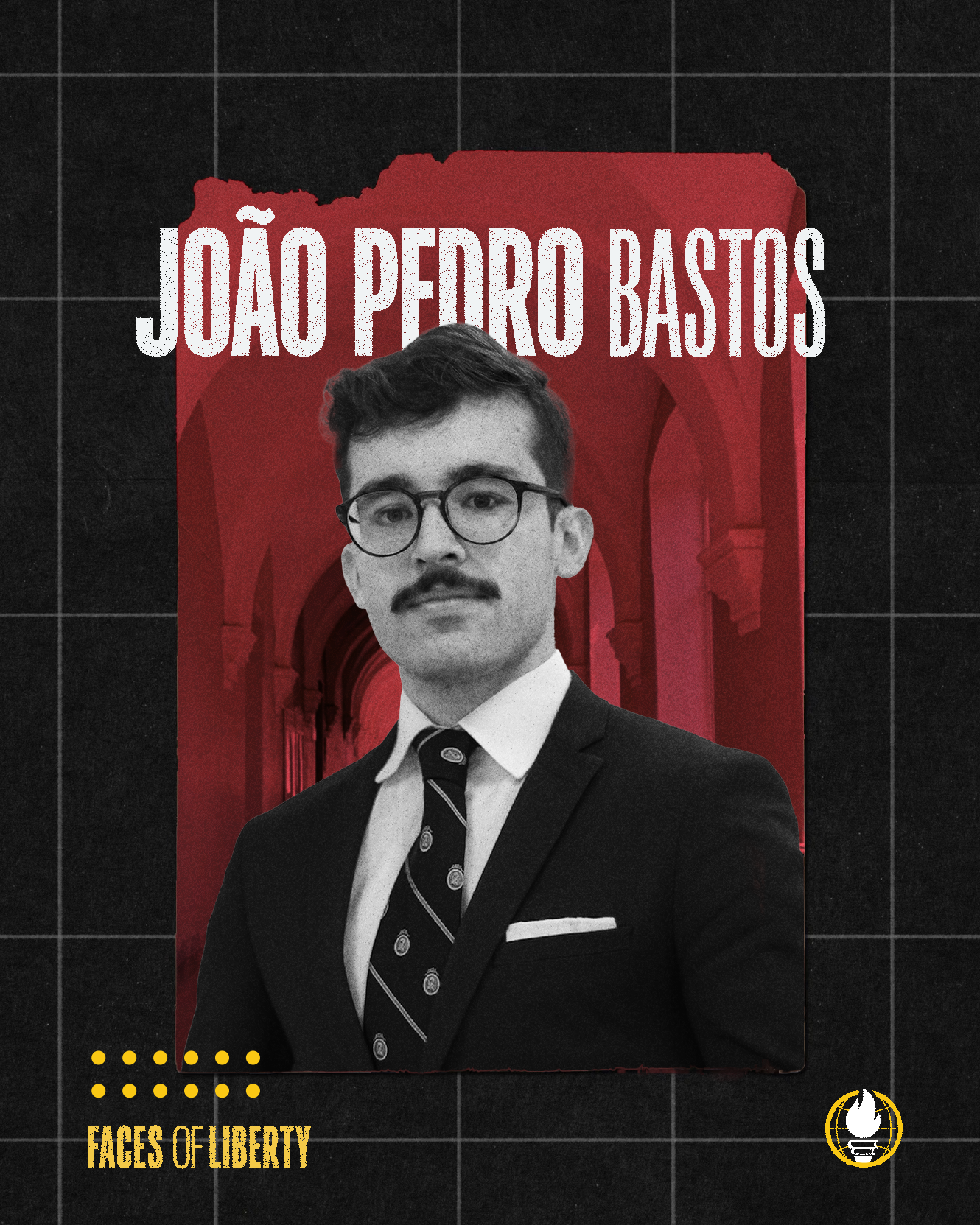
João Pedro Bastos started college at a school in Rio Grande do Sul — Brazil’s southernmost state, close to the Argentine border. He was miserable.
“My class in political economy — which is a subject I love — was a full semester reading Marx,” he said.
It’s not that Marx was on the syllabus. Marx was the syllabus.
“The whole tradition of political economy was boiled down to just one author. And if you disagreed with that, you’d have trouble,” he said.
JP transferred. He kept reading on his own, outside class, looking for the conversations his professors weren’t allowing. In 2015, a classmate invited him to join Students For Liberty. He said … “Sure, I’ll try it.”
He did more than try. He rose quickly through the organization: local volunteer, state volunteer, regional coordinator across Brazil. In 2017, SFL named him one of its top 50 global leaders and invited him to Washington, D.C. for LibertyCon. That trip changed everything.
“I met the Free Market Institute [at Texas Tech University] because in 2017 I was attending LibertyCon in D.C.,” he said. “And they had a booth there in the exposition area. And they were talking about why you should do the PhD with them and learn about economics. REAL economics.”
He chose Texas Tech, packed up, and in 2021, moved to the United States.
Editor’s note: Experience JP’s story in video form at the bottom of this page.
Before that LibertyCon, he had been thinking about grad school but had no clear path — unsure how to fund it, whether to stay in Brazil, how to survive financially while studying. The Free Market Institute detected his talent and passion and solved all of that by offering him a research and teaching assistantship. “Because of SFL,” he said, “I was able to meet FMI … and that opened a whole new opportunity for me and allowed me to pursue a PhD here in the U.S.”
The change SFL sparked in him, though, ran deeper than an educational pivot. Back in Brazil, the SFL chapter he ran organized an economics club that brought outside speakers to campus — conversations the classroom never had.
“I remember there was a minimum wage law that was about to be passed, and so we brought an economist from a think tank foundation. So he could give the students more insight into how that would affect the workers — something that wasn’t happening at all in the classroom,” JP said. “SFL was a huge supplement to my formal education. It really opened the door to create fruitful discussions around topics that the students care about.”
It also kept opening doors after he moved to the States. The value of the SFL network, JP found, isn’t just SFL itself: “All of the partner organizations as well — all of the other think tanks that are partnering with SFL, you can create a huge network of people that have the same goals.” He mentioned PERC, FIRE, and Reason Magazine — all of which he was introduced to when he first joined SFL as a coordinator in southern Brazil.
During his PhD at Texas Tech, he focused on public choice — using economic tools to study political behavior. One paper examined whether Brazilian mayors got rich in office, comparing winners to runners-up in close elections. In municipalities with active local media and real checks on executive power, mayors didn’t enrich themselves. In those without: “The mayor gets really rich — about 50% richer than the runner-up on average over four years.”
The paper won him the Elinor and Vincent Ostrom Prize for Best Graduate Student Paper from the Public Choice Society in 2026. He also co-authored The Forsaken Road, a study showing that the U.S. embargo accounts for less than 10% of Cuba’s post-revolution economic collapse.
JP and his work were featured in the Learn Liberty video below. See JP in action:
And so, when the new University of Austin posted a faculty opening, JP “applied there without thinking twice, and got hired.” He moved to Austin in July of 2026 to be their new Assistant Professor of Economics.
The university was founded on a commitment to free inquiry — exactly the environment JP spent years searching for and never found in Brazil. He’ll teach Intermediate Microeconomics, plus an elective he’s particularly eager for: The Economics of Socialism.
“It’s designed so we can read Marx, yes, but also the Austrians and others, and go over the socialist calculation debate … understand the history of Cuba and the Soviet Union — what they did well, what they did not. And go into the actual data and understand what really happened there.”
And so, with SFL’s support, a student who once sat through a full semester of Marx with no one listening to his arguments will now be at the head of the class, encouraging arguments — with Mises featured prominently on the reading list.