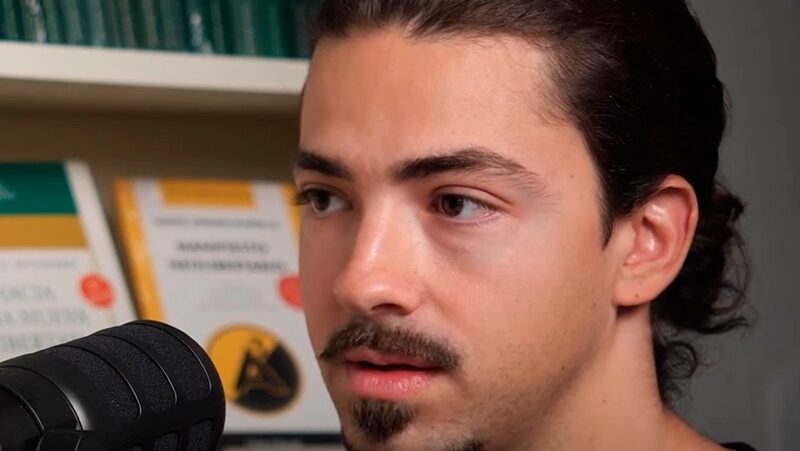
By Valentin Endeiza
There’s a traditional idiom commonly used to begin fairy tales. It tells the audience that the story is set in an unspecified, often magical land, long, long ago.
It goes like this: Once upon a time … there was a TikTok clip.
That’s where the fairy tale began for Jorge Muñoz.
That clip was just a few minutes of Antonio Escohotado: philosopher, historian, and one of Spain’s best minds, explaining individual freedom and government overreach.
Most people would have scrolled past. Most people DID scroll past, in fact.
Not Jorge. He replayed it, searched for the full lecture, and then moved on to the books. From there, he discovered other thinkers exploring similar ideas, people like Juan Ramón Rallo and Miguel Anxo Bastos. The more he learned, the more he wanted to sharpen his own thinking.
But he realized the best way to learn is to teach others, so he started making videos of his own. Not necessarily to go viral, but as a way to better understand and refine the arguments he was studying and making. He began the same way Escohotado first reached him, with short and direct TikTok clips that made complex ideas easier to grasp.

The response surprised him: People were not just watching; they were looking for more. It became clear to Jorge that there was a gap in the Spanish-speaking world: a lot of political noise with very few voices making libertarian ideas accessible.
As it turned out, Jorge was exactly the right voice to fill that gap. His channel was already growing when he connected with Students For Liberty, but joining gave him something the algorithm couldn’t: a real community. Through SFL, he met people like his fellow Galician, Hugo Lopez Quintela, SFL’s national coordinator for Spain; started co-organizing events; and found a network where the debates were genuine and the ideas kept getting sharper.
The short clips he was making for TikTok turned into longer, more detailed videos for YouTube. Within a year, he had surpassed 10,000 followers.
See Jorge’s YouTube channel: Libertad Individual.
That same mindset shaped his podcast, too. Before sitting down with a guest, Jorge spends time preparing, watching past interviews, reading their work, and trying to understand how they think. Most of his guests come from academia — professors and researchers — or are connections from previous conversations and from the libertarian circles he’s connected with through Students For Liberty.
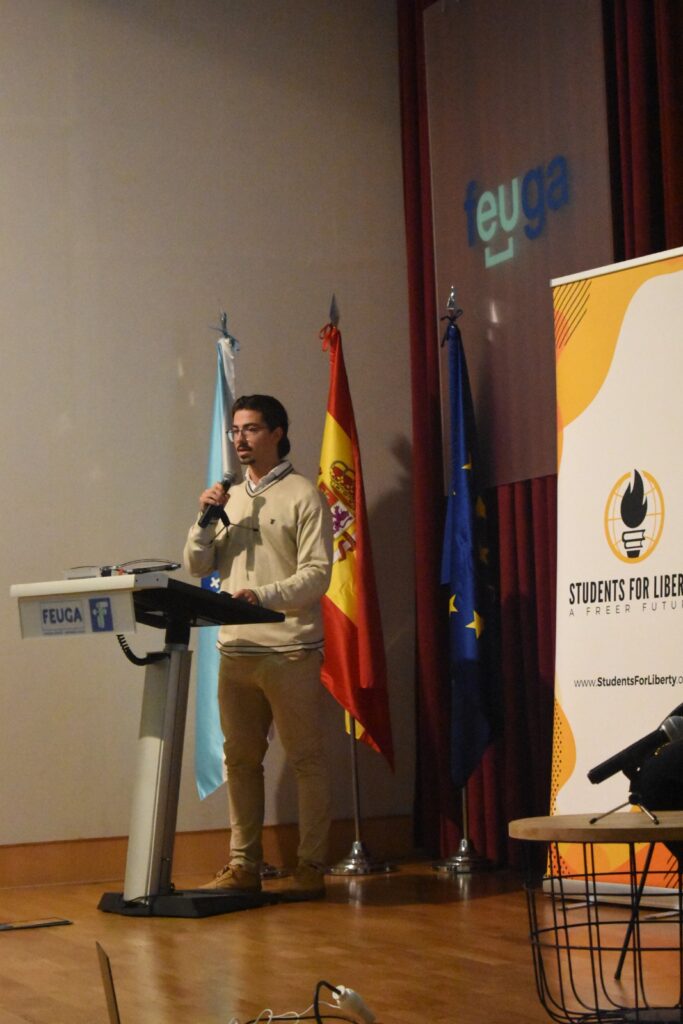
“I never want to catch anyone off guard; quite the opposite,” he said. “I want the conversation to feel natural, like two people genuinely exchanging ideas. In my mind, I’m just someone who came across ideas that changed the way I see the world. And I felt the need to keep talking about them. That’s why the tone is spontaneous, curious, and unhurried.”
The first episode of the podcast was really just an experiment, but it immediately performed better than his usual content. And as of this writing, in April 2026, he is approaching 200,000 subscribers on YouTube. Add to that 120,000 on TikTok and 78,000 on Instagram, and the total climbs past 390,000 people. All of it built without a media budget, without a team, just a 26-year-old from Galicia showing up consistently, sharpening his ideas through connections with other SFLers, and turning every conversation into a chance to learn something new.
But the number that matters most to Jorge is one he cannot really measure: How many people are actually rethinking ideas they once took for granted? Because the most common question he gets is not whether libertarianism is right; he believes most people in his audience have already accepted it on a moral level. The real question is: How would it actually work?
Healthcare, justice, public order: People understand the philosophy, but they struggle to picture the system.
Jorge calls this a “cambio de chip.” A “mental reset.” And he sees it as the core of what he’s doing. It’s not just about making arguments. It’s about making those ideas feel real and possible.
Another real question: What comes next for Jorge? Finishing a master’s degree in Austrian economics, for one, but beyond that, expanding the podcast; launching a newsletter; building a magazine; and organizing live events. At LibertyCon 2026 in Madrid, Jorge is not just attending; he is a partner, a speaker, and one of the organizers. It is the kind of platform that did not exist for him before SFL.
“In-person events matter to me in a different way,” he said, “because ideas do not spread the same on a screen as they do in a room full of people. The people who show up … I know they are really looking for something. Looking for that cambio de chip.”
And Jorge believes libertarian ideas have that something. As he puts it: “The ideas of liberty están aquí y están para quedarse.”
They are here, and they are not going anywhere.
Neither is Jorge Muñoz. He’s just getting started.